PDF Ebook 100 Million Years of Food: What Our Ancestors Ate and Why It Matters Today, by Stephen Le
The factor of why you could obtain and get this 100 Million Years Of Food: What Our Ancestors Ate And Why It Matters Today, By Stephen Le sooner is that this is the book in soft data type. You could review the books 100 Million Years Of Food: What Our Ancestors Ate And Why It Matters Today, By Stephen Le any place you want even you remain in the bus, workplace, home, and other places. Yet, you might not should relocate or bring guide 100 Million Years Of Food: What Our Ancestors Ate And Why It Matters Today, By Stephen Le print wherever you go. So, you won't have larger bag to carry. This is why your option making better idea of reading 100 Million Years Of Food: What Our Ancestors Ate And Why It Matters Today, By Stephen Le is truly helpful from this situation.
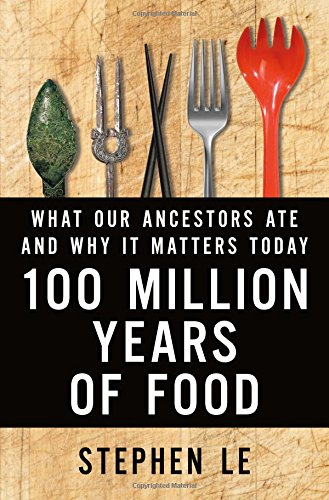
100 Million Years of Food: What Our Ancestors Ate and Why It Matters Today, by Stephen Le

PDF Ebook 100 Million Years of Food: What Our Ancestors Ate and Why It Matters Today, by Stephen Le
100 Million Years Of Food: What Our Ancestors Ate And Why It Matters Today, By Stephen Le. Let's check out! We will certainly typically learn this sentence all over. When still being a children, mama made use of to purchase us to constantly read, so did the instructor. Some e-books 100 Million Years Of Food: What Our Ancestors Ate And Why It Matters Today, By Stephen Le are fully read in a week and also we need the commitment to assist reading 100 Million Years Of Food: What Our Ancestors Ate And Why It Matters Today, By Stephen Le What around now? Do you still love reading? Is reading just for you that have responsibility? Not! We here supply you a brand-new publication qualified 100 Million Years Of Food: What Our Ancestors Ate And Why It Matters Today, By Stephen Le to check out.
As understood, book 100 Million Years Of Food: What Our Ancestors Ate And Why It Matters Today, By Stephen Le is well known as the window to open up the world, the life, and brand-new thing. This is what the people now need so much. Even there are lots of people which do not like reading; it can be a choice as reference. When you truly require the means to develop the following inspirations, book 100 Million Years Of Food: What Our Ancestors Ate And Why It Matters Today, By Stephen Le will actually guide you to the way. Additionally this 100 Million Years Of Food: What Our Ancestors Ate And Why It Matters Today, By Stephen Le, you will certainly have no remorse to get it.
To get this book 100 Million Years Of Food: What Our Ancestors Ate And Why It Matters Today, By Stephen Le, you could not be so confused. This is on-line book 100 Million Years Of Food: What Our Ancestors Ate And Why It Matters Today, By Stephen Le that can be taken its soft data. It is various with the on the internet book 100 Million Years Of Food: What Our Ancestors Ate And Why It Matters Today, By Stephen Le where you can order a book and then the vendor will send out the printed book for you. This is the location where you could get this 100 Million Years Of Food: What Our Ancestors Ate And Why It Matters Today, By Stephen Le by online and after having manage investing in, you could download and install 100 Million Years Of Food: What Our Ancestors Ate And Why It Matters Today, By Stephen Le alone.
So, when you require quickly that book 100 Million Years Of Food: What Our Ancestors Ate And Why It Matters Today, By Stephen Le, it does not should wait for some days to get the book 100 Million Years Of Food: What Our Ancestors Ate And Why It Matters Today, By Stephen Le You could directly obtain the book to save in your device. Even you enjoy reading this 100 Million Years Of Food: What Our Ancestors Ate And Why It Matters Today, By Stephen Le almost everywhere you have time, you could enjoy it to review 100 Million Years Of Food: What Our Ancestors Ate And Why It Matters Today, By Stephen Le It is definitely helpful for you which intend to get the a lot more precious time for reading. Why do not you spend 5 mins as well as invest little money to obtain the book 100 Million Years Of Food: What Our Ancestors Ate And Why It Matters Today, By Stephen Le here? Never allow the brand-new thing quits you.
A fascinating tour through the evolution of the human diet, and how we can improve our health by understanding our complicated history with food.
There are few areas of modern life that are burdened by as much information and advice, often contradictory, as our diet and health: eat a lot of meat, eat no meat; whole-grains are healthy, whole-grains are a disaster; eat everything in moderation; eat only certain foods--and on and on. In 100 Million Years of Food biological anthropologist Stephen Le explains how cuisines of different cultures are a result of centuries of evolution, finely tuned to our biology and surroundings. Today many cultures have strayed from their ancestral diets, relying instead on mass-produced food often made with chemicals that may be contributing to a rise in so-called "Western diseases," such as cancer, heart disease, and obesity.
Travelling around the world to places as far-flung as Vietnam, Kenya, India, and the US, Stephen Le introduces us to people who are growing, cooking, and eating food using both traditional and modern methods, striving for a sustainable, healthy diet. In clear, compelling arguments based on scientific research, Le contends that our ancestral diets provide the best first line of defense in protecting our health and providing a balanced diet. Fast-food diets, as well as strict regimens like paleo or vegan, in effect highjack our biology and ignore the complex nature of our bodies. In 100 Million Years of Food Le takes us on a guided tour of evolution, demonstrating how our diets are the result of millions of years of history, and how we can return to a sustainable, healthier way of eating.
- Sales Rank: #199926 in Books
- Published on: 2016-02-02
- Released on: 2016-02-02
- Original language: English
- Number of items: 1
- Dimensions: 9.45" h x 1.06" w x 6.45" l, 1.14 pounds
- Binding: Hardcover
- 320 pages
Review
“This deliciously entertaining book will help you to enjoy eating your food, to enjoy thinking about your food, and to stay healthy.” ―Jared Diamond, winner of the Pulitzer Prize and the New York Times bestselling author of Guns, Germs, and Steel and Collapse
"The vastness, breadth, and ambitiousness of Stephen Le's 100 Million Years of Food makes it compelling and engaging."―Mark Kurlansky, author of Salt and Cod
"Le mixes advice, personal anecdotes, and medical science in this fascinating food-for-thought narrative."―Booklist
"In this accessible debut, Le offers a nimble hybrid that is equal parts travel memoir and informed speculation about the biology of human nutrition. The author, with roots in Vietnam and Canada, also explores how different cultures approach food in support of his thesis that straying from one's ancestral diets is a leading cause of modern disease. It's a surprisingly clear-eyed approach....The book's conclusions about what to eat and drink are common sense, but the journey Le takes to get us there is worth the cover price."―Kirkus Reviews
About the Author
Stephen Le is currently a Visiting Professor in the Department of Biology at the University of Ottawa. He received a Ph.D. in Biological Anthropology from the University of California, Los Angeles in 2010 where he was a recipient of a UCLA Chancellor's Fellowship and a National Science Foundation grant for his fieldwork in Vietnam. 100 Million Years of Food is his first book.
Most helpful customer reviews
10 of 12 people found the following review helpful.
A mess of a read
By Kay Gold
This book is readable, but I kept waiting for him to have a more comprehensive thesis on what one should eat. Yes, Thai's should eat Thai food, since evolutionary wise, that is what your body processes most easily. He did not touch on Europeans at all. That does me no good. I was looking for information on what I should eat. I did not find it at all in this book. He also gets political about things, and I did not see what some of his comments had to do with the topic. The title should be changed to something like, My travels and views on how we should eat.
4 of 4 people found the following review helpful.
evolved to seek out food that is sweet, but because of this we not only develop ...
By Tracet
One thought that kept recurring while reading 100 Million Years of Food was how thoroughly this all seems to put paid to the idea of "Intelligent Design". Because my overall conclusion from all of this is, lord, these bodies are not well put together. We are, apparently, evolved to seek out food that is sweet, but because of this we not only develop our crops for sweetness at the expense of other, more healthful, attributes, but the sweetness really does go straight to our hips. And hearts. And teeth. The diet of Western civilization leads to the the "diseases of Western civilization": "obesity, type 2 diabetes, gout, hypertension, breast cancer, food allergies, acne, and myopia"… Diet contributes to myopia? That's still something I need to research. Must remember to ask my ophthalmologist. I saved this: "children who play outside more frequently were found to be less nearsighted" – because THAT explains a lot. (Vitamin D deficiency? The activities that take the place of playing outdoors? I was doomed from the start.)
What kept startling me throughout the book was the assertion that – kind of as Susan Cain revealed that introversion is inborn and can't be easily ignored – there is just nothing you can do about some things, because one's dna has a lot to do with how well one does (or doesn't) thrive in a given environment. Stephen Le uses himself as the exemplar: the area of the globe his ancestors evolved to adapt to, Vietnam, supports a diet which is wildly different from what he grew up with in 20th century Ottawa, and perhaps there is a connection to the fact that his mother only survived her mother by a couple of years. Traditional cuisines adapt to the ecology native to a place, and the people of the area adapt to the traditional cuisine. The book slanted a different light on emigration for me: perhaps there is a bone-deep reason why some people don't thrive when transplanted… which, given the human urge to explore and wander, leads me back to amazement at the human body's fallibility. (Aha, there it is: "when Europeans started to populate sunny colonies in the Americas and Oceania beginning a few hundred years ago, and people from the tropics, like my parents, moved in the opposite direction, to frigid climes, the wonderfully adapted skin color suddenly became a liability.")
Oh, and then there's the little fact of multiple cases of "such-and-such is good for you, but if you succumb to the usual human thinking that 'if some is good more is better!" you will suffer or perhaps die"… Like: "Animals that browse too much on isoflavone-rich plants, such as ewes feeding on clover, can become sterile". And "Others worry about vitamin D deficiency and pop vitamin D pills, but the problem is that no one knows exactly how much vitamin D is a healthy dosage or how vitamin D supplements influence our immune system and increase our risk for diseases like cancer." Or the fact that eating animal products make you grow taller and stronger and all sorts of other good things, but will kill you earlier in the end. Or "In 1966, researchers in Israel observed that the incidence of multiple sclerosis increased with better sanitation, such as cleaner drinking water, less crowding, and the availability of flush toilets." Or "For middle-aged people, consumption of cholesterol and fat is likely to improve mood and sex drive, while there is not much evidence for long-term weight loss”.
Counterintuitive much? No wonder we're all so messed up.
The writing is a lot of fun. ("She brought a bottle of her home-brewed fermented soybean sauce to our house. It smelled like old shoes and tasted like tofu would if it went to a bar, got drunk, was mugged on the way home, and woke up with a hangover.") This is pop science at its best – mass quantities of excellent (if often depressing) information presented in a compulsively readable manner, and carried along by the author's own background and experience. One place this, hilariously, shows up is in the brief quotes that head each chapter:
The supreme irony is that all over the world monies worth billions of rupees are spent every year to save crops . . . by killing a food source (insects) that may contain up to 75% of high quality animal protein. — M. Premalatha et al., "Energ y- Efficient Food Production to Reduce Global Warming and Ecodegradation: The Use of Edible Insects"
If you eat that ant, I'll never kiss you again. — Ex- girlfriend during camping trip
I finished the book with a handful of nascent crusades roiling around in my heart – Save the red squirrels! Get everyone (except perhaps me) eating insects! Exercise (after one more chapter…)! Stamp out MSG (also known as autolyzed yeast, sodium caseinate, hydrolyzed vegetable protein)! Make sure all hospitals and nursing homes have only sunny and south-facing windows! Find whipworm eggs online - ! Wait. No. Not that one.
I received this book from Netgalley for review.
3 of 3 people found the following review helpful.
hard to digest
By Ken Kardash
I thought this might be a critical examination of the current Paleo and other diet fads that claim to be based on our evolutionary heritage. The fact that it was written by an anthropologist gave it some academic credibility. Sadly, like a trip down the digestive canal, the end result bore little resemblance to the initial appearance.
In fact, there is very little information here about what ancient cultures ate, and how we know. The author tries to make up for this by obsessively citing current science regarding diet and health, but this is not the story he promised to tell us.
As if to distract from this switch in subject matter, the explorations of different dietary styles are couched in a sort of globe-trotting culinary travelogue. But Anthony Bourdain this is not. I found the irrelevant personal anecdotes irritating. I grew especially tired of the insistent, self-pitying references to being an impoverished graduate student and graphic descriptions of his digestive processes.
After this literally wandering story, the author dives off the edge of his pile of references to make some recommendations. In a book devoted to diet, we are told at the end that the most important thing is to exercise more. Yet earlier there is a confusing argument that we actually burn calories relative to our metabolism at about the same rate as our foraging ancestors. Oh, and avoid eating meat while young, but switch when older. Right. When he got to advocating ingesting parasites to control the immune system, I had had enough. In a primordial human dietary adaptation, my stomach just couldn’t take it.
See all 16 customer reviews...
100 Million Years of Food: What Our Ancestors Ate and Why It Matters Today, by Stephen Le PDF
100 Million Years of Food: What Our Ancestors Ate and Why It Matters Today, by Stephen Le EPub
100 Million Years of Food: What Our Ancestors Ate and Why It Matters Today, by Stephen Le Doc
100 Million Years of Food: What Our Ancestors Ate and Why It Matters Today, by Stephen Le iBooks
100 Million Years of Food: What Our Ancestors Ate and Why It Matters Today, by Stephen Le rtf
100 Million Years of Food: What Our Ancestors Ate and Why It Matters Today, by Stephen Le Mobipocket
100 Million Years of Food: What Our Ancestors Ate and Why It Matters Today, by Stephen Le Kindle
100 Million Years of Food: What Our Ancestors Ate and Why It Matters Today, by Stephen Le PDF
100 Million Years of Food: What Our Ancestors Ate and Why It Matters Today, by Stephen Le PDF
100 Million Years of Food: What Our Ancestors Ate and Why It Matters Today, by Stephen Le PDF
100 Million Years of Food: What Our Ancestors Ate and Why It Matters Today, by Stephen Le PDF